What is thyroid cancer?
Thyroid cancer originates from abnormal cell growth within the thyroid gland, a butterfly-shaped organ situated at the base of the neck, below the Adam’s apple. This gland plays a crucial role in regulating heart rate, blood pressure, body temperature, and weight by producing hormones.
Initially, thyroid cancer may not present any noticeable symptoms. However, as the tumor progresses, individuals may experience manifestations such as neck swelling, changes in voice, and difficulty swallowing.
Various types of thyroid cancer exist, with the majority exhibiting slow growth rates, although some aggressive forms are also recognized. Fortunately, most cases of thyroid cancer are treatable with appropriate medical intervention.
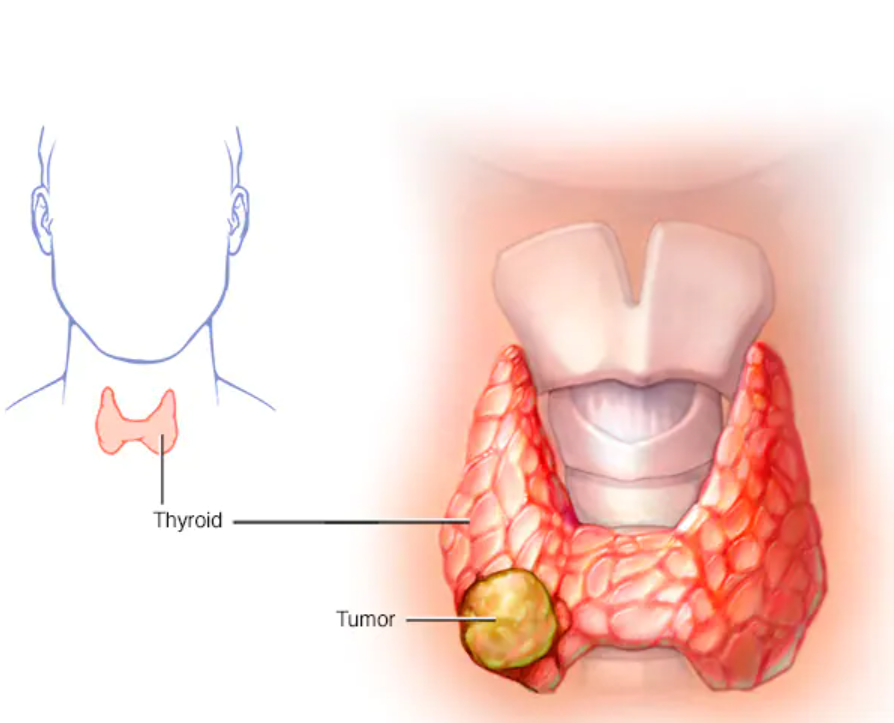
There appears to be a rising trend in thyroid cancer incidence rates, potentially attributed to advancements in imaging technology. Improved diagnostic capabilities, such as CT and MRI scans, enable healthcare providers to detect small thyroid cancers incidentally while investigating other medical conditions. Typically, these incidental findings involve small, manageable cancers that respond well to treatment protocols.
Symptoms
Most thyroid cancers don’t cause any signs or symptoms early in the disease. As thyroid cancer grows, it may cause:
- A palpable lump (nodule) noticeable on the surface of your neck.
- Sensation of tightness or discomfort in close-fitting shirt collars.
- Alterations in voice quality, such as heightened hoarseness.
- Challenges with swallowing.
- Enlarged lymph nodes in the neck.
- Discomfort or pain experienced in the neck and throat region.
Causes
Thyroid cancer occurs when cells within the thyroid undergo alterations in their DNA. DNA serves as the blueprint guiding cellular functions. These mutations, identified by doctors, prompt rapid cell proliferation, enabling the cells to persist beyond their natural lifespan. The resulting accumulation of cells forms a mass known as a tumor.
As the tumor progresses, it may infiltrate neighboring tissue and potentially metastasize to the lymph nodes in the neck. In some cases, cancer cells may extend beyond the neck, spreading to distant sites such as the lungs, bones, and other organs.
The precise triggers for the DNA changes leading to most thyroid cancers remain unclear.
Types of thyroid cancer
Thyroid cancer is categorized into distinct types depending on the specific cell characteristics observed within the tumor. Your cancer type is identified through microscopic examination of a tissue sample obtained from the affected area. This classification plays a significant role in shaping your treatment approach and predicting your prognosis.
The main types of thyroid cancer include:
- Papillary thyroid carcinoma: This is the most common type, accounting for approximately 80% of thyroid cancer cases. It typically grows slowly and has a good prognosis.
- Follicular thyroid carcinoma: This type accounts for about 10-15% of thyroid cancers. It tends to spread to distant sites more often than papillary carcinoma.
- Medullary thyroid carcinoma: This type arises from the parafollicular cells (C cells) of the thyroid gland and accounts for approximately 5-10% of cases. It may be associated with inherited genetic syndromes.
- Anaplastic thyroid carcinoma: This is the rarest and most aggressive type of thyroid cancer, accounting for less than 2% of cases. It grows rapidly and is often resistant to treatment.
- Thyroid lymphoma: This type is extremely rare and arises from lymphocytes within the thyroid gland. It usually presents as a rapidly enlarging mass in the neck.
- Hurthle cell carcinoma: Also known as oxyphilic cell carcinoma, this type is a subtype of follicular thyroid carcinoma and is characterized by the presence of large, pink-staining cells known as Hurthle cells.
Risk factors
Factors that may increase the risk of thyroid cancer include:
- Gender: Thyroid cancer is more prevalent among women, potentially linked to higher estrogen levels typically found in individuals assigned female at birth.
- Radiation exposure: High levels of radiation therapy targeting the head and neck region can elevate the likelihood of developing thyroid cancer.
- Genetic predisposition: Certain inherited genetic syndromes, such as familial medullary thyroid cancer, multiple endocrine neoplasia, Cowden syndrome, and familial adenomatous polyposis, heighten the risk of thyroid cancer. Types of thyroid cancer associated with familial inheritance include medullary thyroid cancer and papillary thyroid cancer.
Complications
Thyroid cancer recurrence is possible despite successful treatment, even in cases where the thyroid has been surgically removed. This scenario may occur if cancer cells have already spread beyond the thyroid gland prior to its removal.
The majority of thyroid cancers, including the common types like papillary and follicular thyroid cancer, have a low likelihood of recurrence. Your healthcare provider can assess the risk of recurrence based on the specific characteristics of your cancer.
Recurrence becomes more probable in cases where the cancer displays aggressive behavior or extends beyond the confines of the thyroid gland. Typically, instances of thyroid cancer recurrence are detected within the initial five years following the initial diagnosis.